Traffic signs built on aluminum, faced with film — never paint
Warning, regulatory, guide and work-zone panels on 2.0 or 3.0 mm aluminum, faced with YEAGOOD reflective sheeting and drilled to your post pattern. We build to MUTCD, EN 12899-1, GB 5768 or the clause you send us.
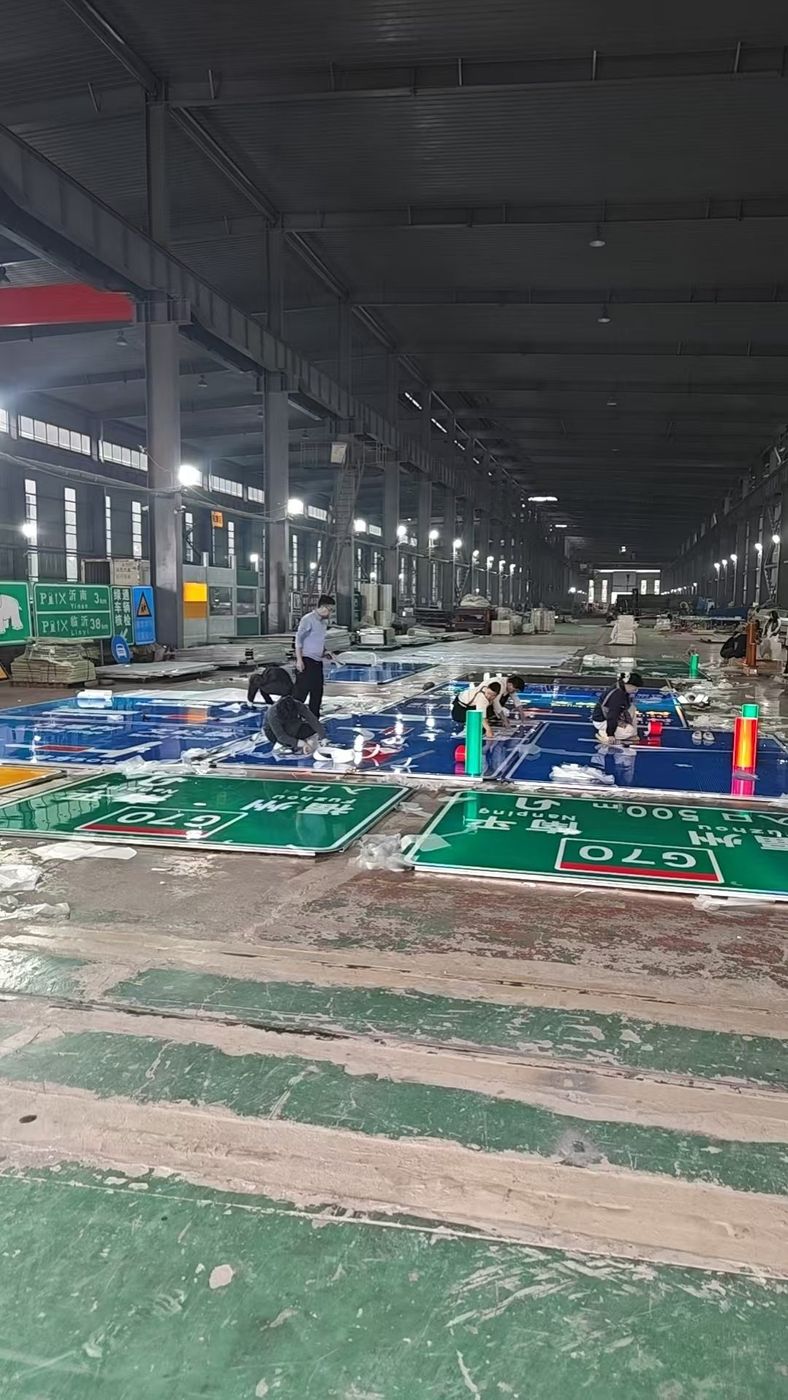
Sign families we build
Warning, regulatory, guide, work-zone and parking signs on 2.0 or 3.0 mm aluminum, faced with reflective sheeting and drilled to your post pattern.
Every sign starts as a blank cut from 3003-H14 or 5052-H38 sheet, is deburred and radiused, then goes to the laminator and the press. Nothing is painted: the reflective surface is film, and the legend is printed into or onto that film, so retroreflectivity is uniform from edge to edge instead of thinning where a spray gun passed.
Sheeting grades, by road type
The film decides the price and the life of the sign. This is the mapping we recommend when a buyer sends a schedule without a grade on it.
| Grade | Structure | ASTM D4956 | Vertical life | Where it belongs |
|---|---|---|---|---|
| Engineering | Glass bead | Type I | 3–5 years | Car parks, estate roads, temporary works |
| High-intensity | Prismatic | Type III / IV | 7–10 years | Urban and secondary roads, regulatory signs |
| Microprismatic | Microprismatic | Type VIII–XI | 10–12 years | Expressways, guide signs, high mounting |
ASTM D4956 type numbers describe the minimum coefficient of retroreflection for white sheeting at 0.2° observation and −4° entrance. Confirm the exact type against the product datasheet before you write it into a tender.
Construction and tolerances
A sign is three decisions: how thick the aluminum, which film, and how it attaches. Get the first two right and the third is arithmetic.
- Substrate
- 3003-H14 at 2.0 mm (standard) or 5052-H38 at 3.0 mm (wind, coastal, large panels)
- Panel size
- Up to 1500 × 3000 mm single panel; larger as a seamed assembly
- Panel tolerance
- ±1 mm on overall size, ±0.5 mm on hole position, squareness ≤ 1 mm/m
- Film
- YEAGOOD YM series, ASTM D4956 Type I–XI, applied on a roll laminator and edge sealed
- Legend
- Screen print with translucent inks under clear overlay, or UV digital print
- Backing
- 6063 channel in 60–120 mm sections, Z-stiffeners on panels over 1.5 m
- Fixing
- Holes and slots to your post pattern, Ø6–12 mm, stainless or galvanised fasteners on request
- HS code
- 8310.00 — sign plates, name plates, address plates and similar, of base metal
Film grades by the Chinese national standard
Chinese domestic work is specified against GB/T 18833, classes I to V. If you buy for a Chinese-funded project abroad, or compare against a domestic quotation, this is the scale the supplier means — and here is what each class is used for at the factory.
| Class | Construction | Service life | Where it is used |
|---|---|---|---|
| I (工程级) | Glass bead / microprismatic entry grade | 7 years | Rural roads, car parks, low-speed works |
| II (超工程级) | Sealed-bead or microprismatic | 10 years | County roads, low-speed permanent signs |
| III (高强级) | Encapsulated lens, high intensity | 10 years | Provincial roads, urban secondary roads, industrial zones |
| IV (超强级) | Microprismatic | 10 years | National and provincial highways, urban arterials, expressways |
| V (大角度反光膜) | Wide-angle microprismatic | 10 years | Motorways, urban fast roads, overhead signage |
Class roman numerals follow the current revision of GB/T 18833; the Chinese names in brackets are how the classes are written on domestic drawings.
Extruded-panel signs for typhoon zones
For coastal cities and coastal highways, large faces are not made from one sheet: they are assembled from extruded aluminium sections bolted into a panel. The construction is stiffer and flatter than a rolled sheet of the same size, it is specified to resist typhoon-force winds of force 12 and above, and it has a practical advantage on site — a damaged face can be replaced section by section instead of renewing the whole sign.
We extrude the sections and assemble the panels in the same workshop, so the panel size, the section and the inner graphic can all be changed without a new tool. If your specification is written around a single rolled sheet, ask for the extruded alternative before you lock the drawing — on large faces it is usually the better structure.
Standards by market
We build to the design standard of the destination market, not to a single house style. Tell us the country and the road class and we will quote against the right column.
| Market | Design standard | Sheeting standard | Our default |
|---|---|---|---|
| United States | MUTCD (11th edition) | ASTM D4956 | Type III or IV, 0.080 in / 2.0 mm |
| European Union | EN 12899-1 | EN 12899-1 RA1–RA3 | RA2 microprismatic |
| Gulf and MENA | National codes on MUTCD / EN basis | ASTM D4956 | Type IV or VIII |
| China | GB 5768 | GB/T 18833 class I–V | Class IV or V |
| Central Asia / CIS | GOST 32945 series | GOST 32945 | Type III equivalent |
| Australia / NZ | AS 1742 series | AS/NZS 1906.1 | Class to your schedule |
Where a national code is not listed, send the clause and we will build to it — most markets reference either MUTCD or EN 12899.
Substrate by market
Aluminum is the mainstream sign substrate worldwide, but every market specifies it differently — by alloy name, by thickness, and by how much galvanized steel still competes with it. We quote to the table below and flag the exceptions before you write a spec.
| Market | Dominant substrate | Typical specification | What drives the choice |
|---|---|---|---|
| Gulf and MENA (UAE, Saudi, Qatar) | Aluminum, heaviest gauges | 5052-H38 (or 5086), 2.0–3.0 mm — 3.0 mm mandatory for Ø750 mm+ and gantry panels; reverse face powder-coated for heat reflection | Budget-insensitive road authorities; extreme heat and wind loads; Type XI film demanded alongside |
| Southeast Asia (VN, TH, ID, PH) | Aluminum | 3003-H14 or 5052-H38, 1.2–2.0 mm; 1.2 mm common on regulatory circles | National codes (QCVN 41:2019, SNI, MUTCD-based); corrosion from humidity rules out bare steel on permanent signs |
| Central Asia / CIS (KZ, UZ, KG) | Galvanized steel, aluminum rising | GOST tradition: galvanized steel 0.8–1.2 mm, double-flanged; aluminum AMg2 (≈5052) 1.5–2.0 mm on federal roads and new-build projects | Legacy GOST 32945 procurement; the steel-to-aluminum transition is where an aluminum supplier wins displacement volume |
| East, West and North Africa | Aluminum | 3003-H14, 1.5–2.0 mm; coastal projects specify aluminum explicitly over steel | EN 12899 or MUTCD derivatives; salt-air corrosion on the seaboard and donor-funded project specs |
| Southern Africa | Coated steel, aluminum niche | 1.4 mm pre-painted galvanized steel (Chromadek-type) is the local default; aluminum 3.0 mm specified only for coastal and long-life sites | Local steel production, purchase price, and aluminum's scrap value attracting theft (SARTSMA guidance) |
Alloy naming: 5A02 is the Chinese designation equivalent to 5052; 1060/1100 is the economy grade used on low-speed roads. Aluminum-plastic composite panel (ACP, 3–4 mm) is gaining share in Russia as a mid-price substrate — we quote solid aluminum against it on flatness and edge integrity.
Printing, packing and shipping
Long-life work is screen printed: translucent inks go onto the sheeting and a clear overlay goes on top, so the legend is protected by film rather than exposed to sun and washing. Short runs and multi-colour guide signs are UV printed, which removes the screen cost but gives a shorter outdoor life.
- Packing
- 25–50 panels per plywood crate, face-to-back with interleaf, corner and edge protection
- Crate volume
- Roughly 0.9–1.2 m³ per crate; panels over 1.5 m travel in a dedicated crate
- Container
- A 20′ takes 350–450 m² of panel face depending on thickness and crate mix
- Documents
- Invoice, packing list, certificate of origin; test report and batch coupons on request
- Payment
- 30% deposit / 70% against copy of B/L; L/C at sight for larger programmes
Buyer questions
Which sheeting grade should I specify?
Match the grade to the road, not to the catalogue. Engineering grade (Type I) for car parks and low-speed estate roads; high-intensity prismatic (Type III–IV) for urban and secondary roads; microprismatic (Type VIII–XI) for expressways and anywhere the sign has to read at 200 m or from a high-mounted position.
Can you print our national sign designs?
Yes. Send artwork as AI, CDR, PDF or a dimensioned photo, plus the colour reference. We print to the drawing and return a proof for approval before production; on long-life work the legend is screen printed with translucent inks and covered by a clear overlay.
Do you supply posts and gantries?
No. Panels, blanks and channel are our range; posts, gantries and foundations are not. We drill and slot the panel to the post pattern you specify, and we will check your pattern against the panel size before cutting.
What is the largest panel you can make?
1500 × 3000 mm as a single panel in 3.0 mm 5052. Anything larger is built as a seamed assembly on channel, with the seams placed to fall on a colour boundary so they disappear at distance.
How do you control colour?
Film is supplied to a colour specification and checked with a spectrophotometer against the retained master, ΔE ≤ 2. Printed legends are matched to the same master. We keep a coupon from every batch so a reorder two years later still matches.
Should we buy aluminum or galvanized steel blanks?
It depends on the market and the road class, and we will say so rather than sell you aluminum everywhere. Gulf and Southeast Asian road authorities specify aluminum; East, West and North African coastal projects prefer it for corrosion resistance; some Central Asian tenders are still written around galvanized steel, where we quote aluminum as an equivalent-substrate alternative with the weight and stiffness comparison for the engineer's approval. What we do not offer is painted steel — if the tender demands it, we would rather you know early.
What is the minimum order?
20 panels or 50 m² of face area, whichever comes first, and mixed designs count together because they run on the same program.
What is the lead time?
15–20 days for stock film grades, 25–30 days where the film has to be ordered in. Sea freight from Qingdao adds 18–35 days depending on destination.
Related
Send the sign schedule and the destination country.
We will map each design to a sheeting grade, a panel thickness and a post pattern — then price it.