Aluminum sign blanks, cut to size and ready for film
Blank substrates in 3003-H14, 5052-H38 and 1060-H24 from 1.5 to 4.0 mm: cut to your drawing, corners radiused, edges deburred, mounting holes punched to your post pattern. Film can be applied here or left to your own line.
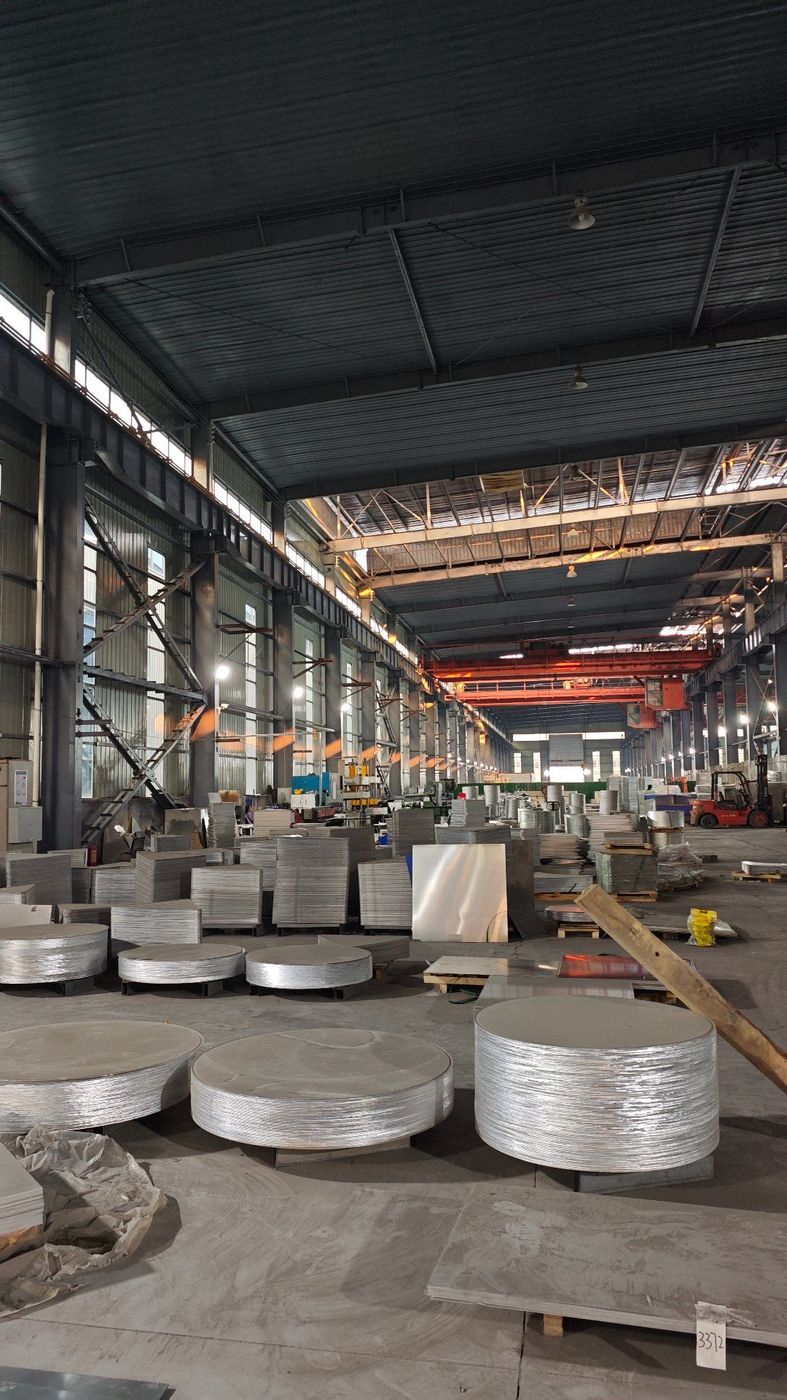
What a blank is, and what we do to it
A blank is a substrate, not a sign: cut to size, deburred, drilled if you want it drilled, and flat enough that the film goes down without a bubble.
The usual starting point is 3003-H14 at 2.0 mm, which is stiff enough for a 900 mm panel on two posts and still bends without cracking. 5052-H38 goes where the sign faces wind, vibration or salt; 1060-H24 for indoor and short-life work where price decides.
We cut with a shear or a fiber laser, radius the corners to the drawing, deburr, punch the mounting pattern, then either pack the blank bare or laminate film on it. Everything except anodising happens under one roof, which is why the lead time is days and not weeks.
Standard sizes and thicknesses
These are the sizes that move. Anything inside 1500 × 3000 mm can be cut to order at no tooling cost, because there is no tool — only a program.
| Size (mm) | Shape | Typical use | Thickness | Edge |
|---|---|---|---|---|
| 600 × 600 | Square | Regulatory, parking, information | 1.5 / 2.0 | Radiused |
| 750 × 750 | Diamond (30 in) | Warning signs | 2.0 / 3.0 | Radiused |
| 900 × 900 | Triangle / square | EU warning, large regulatory | 2.0 / 3.0 | Radiused |
| Ø 600 / 750 / 900 | Circle | Speed limits, prohibitions | 2.0 | Rolled edge on request |
| 1000 × 1000 | Square | Guide and direction | 2.0 / 3.0 | Radiused |
| 1200 × 1200 | Square | Guide, junction layouts | 3.0 | Radiused |
| 1200 × 1800 | Rectangle | Large guide panels | 3.0 | Radiused, stiffener holes |
| To drawing | Any | Custom shapes, gore, chevron | 1.5–4.0 | Any |
Diamond blanks are cut as a square and mounted rotated 45°; the corner radius stays at R10 unless the drawing says otherwise.
Film facing
Blanks can leave bare or faced. If we face them, the film is YEAGOOD sheeting from the YM series — engineering, high-intensity prismatic or microprismatic — applied on a roll laminator at controlled nip pressure, then trimmed and edge sealed.
We can print the legend before or after lamination depending on the ink system: screen printing with translucent inks sits under a clear overlay for long-life work, digital printing goes straight onto the sheeting for short runs and multi-colour guide signs.
We do not paint sign faces. Every reflective surface we sell is film on aluminum. Paint thickness varies across a panel and kills retroreflectivity at the edges — which is exactly where an inspector puts the instrument.
Packing
Blanks are interleaved, corner-protected and crated in plywood, 25–30 pieces per crate depending on thickness — roughly 0.9 m³ and 700–900 kg. Crates stack two high in a 20′ container and are labelled with size, alloy, thickness and film grade.
If the blanks will be printed at your end, tell us and we will pack face-to-back with a paper interleaf rather than film-to-film, so the surface arrives unscuffed.
Buyer questions
Can you punch the holes to our post pattern?
Yes. Send a DXF, a PDF drawing or even a photo with dimensions; we punch or laser the mounting holes and slots to your spacing, typically ±0.5 mm on position. If you use two different post systems, we can punch both patterns on the same blank.
Do you apply the reflective film, or do we?
Either. We laminate YEAGOOD film in house with a roll laminator, seal the edges and pack between interleaves. If you buy unfaced blanks and film locally, you avoid the film's freight and duty — many of our customers in Africa and Central Asia do exactly that.
What flatness can you hold?
3 mm per metre on standard stock, 1.5 mm per metre on request for large guide panels. Flatness is measured on a plate table before packing, and a bowed panel is the most common complaint we hear about other suppliers.
Are the edges treated?
Every blank is deburred on both faces and the edge. After filming we seal the edge with a thin clear tape so water cannot creep under the sheeting — this is the difference between a three-year sign and a ten-year one.
Can blanks be anodised or powder coated?
Anodising is available through a partner line, 10–15 µm, natural or bronze. We do not powder coat sign faces: our process is film on bare aluminum, which keeps the retroreflective surface untouched by paint thickness variation.
What sizes do you keep in stock?
600 × 600, 750 × 750, 900 × 900, 900 mm diameter, 1000 × 1000 and 1200 × 1200 mm in 2.0 mm 3003-H14. Anything else is cut to order, up to 1500 × 3000 mm.
Related
Send the sizes and the post pattern.
A cut list and a drawing is all we need — you get the blank price per piece and the crate count.