Aluminium channel, extruded to your profile
6063-T5 sections for furniture and interior trim, industrial frames, signs and architectural edges. Work from a drawing or a sample; cut to the length your frame needs.
What we extrude
6063-T5 channel and profile, extruded to your drawing — for furniture and interior trim, industrial frames, sign and display work, and architectural edges.
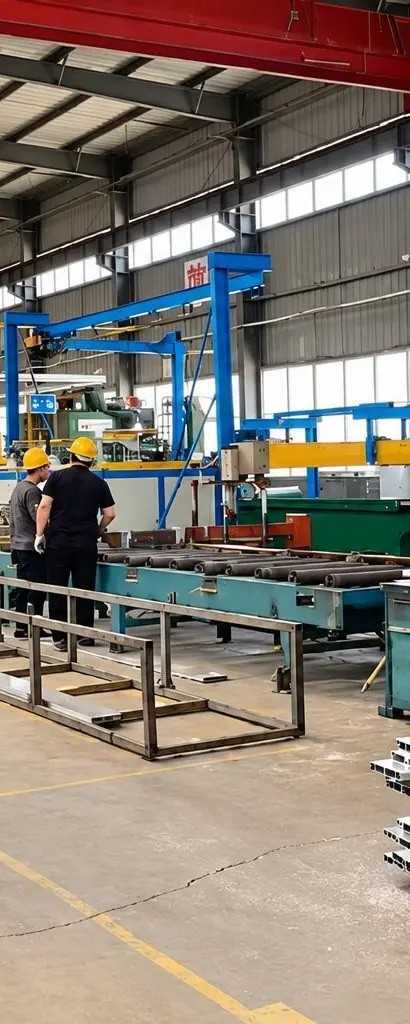
The press and the die shop sit in the same building as the sheet line, which is the reason this page exists: a customer who buys cut sheet for a sign frame usually needs the channel that stiffens it, and both can leave on one pallet with one set of documents.
We work from a drawing, a sample or a section you already buy. If the profile exists as a die we hold, the order starts at cutting; if it does not, a die has to be made first, and that is a one-off cost quoted separately from the metal.
Which industries buy this channel?
Four groups, and they ask for different things. The section is usually similar; what changes is the wall thickness, the surface finish and how tight the cut length has to be.
| Market | Typical sections | What they specify | What decides the price |
|---|---|---|---|
| Furniture and interior trim | Wardrobe and cabinet frames, sliding-door track, skirting and edge trim | Colour and finish match, straightness, cut length to the millimetre | Surface finish and packing, not the metal |
| Industrial frames and equipment | Machine frames, guarding, work-table section, conveyor rail | Wall thickness, hole and slot pattern, squareness of cut | Tolerance and secondary machining |
| Signs and display | Sign channel 60#–110#, light-box frame, poster and banner section | Section depth, fixing spacing, anodised or mill finish | Die size and wall thickness |
| Architectural trim and ceiling | Ceiling grid, corner and shadow-gap trim, soffit edge, cladding bead | Anodising class, colour consistency across batches | Surface treatment and batch size |
Wall thickness in this range runs from about 0.8 mm to 4.0 mm. Below 1.0 mm the section is possible but the tolerance band widens, and it is worth saying so before the die is cut rather than after.
How a profile order runs
Seven steps, and only one of them can surprise a buyer — the die. Everything after it is scheduling.
Which surface finish, and what does it cost you later?
Finish is where a cheap quotation becomes an expensive installation. Mill finish is fine indoors and dry; anodising is the right answer where the profile will be seen and touched for a decade; powder coating gives colour freedom but hides nothing.
| Finish | What it is | Best for | Watch out for |
|---|---|---|---|
| Mill finish | As extruded, natural oxide | Frames that will be covered, indoor dry use, further fabrication | Handling marks show; no colour consistency promise |
| Anodised | Electrolytic oxide layer, integral with the metal | Interior trim, coastal and exterior architectural work | Batch-to-batch colour shift; specify the class in microns |
| Powder coated | Dry paint film, cured | Colour matching a scheme, furniture, display frames | Chips at cut ends and screw heads; touch-up is visible |
Anodising is quoted by micron class, powder by colour reference and gloss level. "Anodised" and "coated" on their own are not specifications — both leave the supplier free to choose the cheapest compliant option.


Cutting, packing and the minimum
Sections are cut on the saw to the length you order, deburred, and bundled with interleaving so the faces do not rub in transit. Long lengths are the packing problem: a 6 m bundle needs support along its whole length, and a container load has to be planned around that rather than around weight.
- Alloy and temper
- 6063-T5 as standard; 6061-T6 for structural sections, quoted separately
- Wall thickness
- About 0.8–4.0 mm depending on section; below 1.0 mm tolerance widens
- Cut length
- 3 m and 6 m standard, or cut to your frame length
- Cut tolerance
- ±1.0 mm on the saw; ±0.5 mm on a second operation
- Surface
- Mill · anodised to a stated micron class · powder coated to a colour reference
- Packing
- Bundled, interleaved, wrapped; long lengths supported end to end
- Minimum
- One bundle, mixed sections allowed if they share a finish
- Standards
- EN 755 / GB/T 6892 for extruded bar, rod and profile; EN 515 for temper
Buyer questions
Do you make a new die, or only run existing sections?
Both. Existing dies start at cutting, with no tooling charge. A new die is quoted as a one-off against your drawing, and the first extrusion off it is sent for approval before the run continues.
What is the minimum order for a profile?
One bundle, and mixed sections are allowed if they share a finish. Below that the set-up and packing dominate the price, and it is usually cheaper to take the bundle than to argue about the quantity.
Can you anodise to a specific class?
Yes — anodising is quoted by micron class, so tell us the class your specification names. If it only says "anodised", we will propose a class and write it on the quotation so both sides know what is being supplied.
Is sign channel the same as architectural channel?
No. Sign channel is a specific family of sections sized for stiffening a panel, with fixing spacing that holds over a 3 m span. Architectural and furniture profiles are usually lighter and chosen for appearance. Both come off the same press — see the sign channel page for the section table.
Can channel ship with sheet on the same pallet?
Usually yes, and it is cheaper than two shipments. Long sections may need their own bundle for support, but they can travel in the same container with one set of documents.
Related
Send a section drawing or a sample.
We come back with the die cost, the metal cost and the cut length in one quotation.