Reflective film, cut to the size your press takes
Six YEAGOOD prism grades in stock, Type II to Type V — slit, sheeted or plotter-cut to your panel size on our own cutting line. We are their appointed export agent, and we buy by the pallet for our own signs.
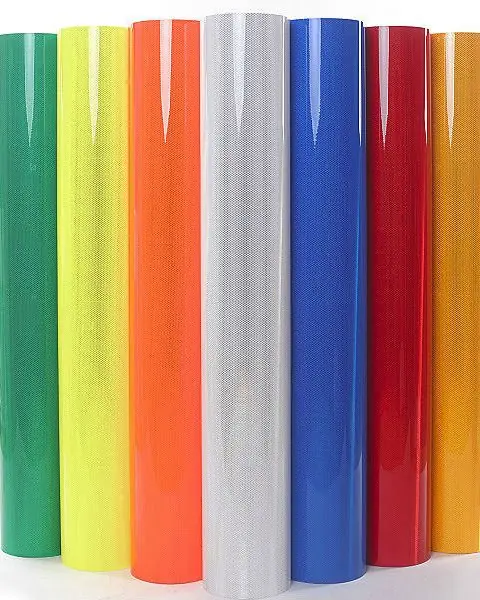
Six grades, in stock, cut the way you need them
A film roll leaves the factory 1.22 m wide and 45.7 m long. Almost nobody laminates at 1.22 m, and almost nobody wants 45.7 m of one width — so the useful part of this page is not the roll size, it is what we cut it down to.
We stock six YEAGOOD prism grades and run the slitting, sheeting and plotter line that turns them into what your press actually feeds. That is why the film is here at all: we face every sign we build with it, we buy by the pallet, and we hold stock instead of ordering per job.

YM6670
Polycarbonate micro-prismatic. Car parks, estate roads and work zones — the cheapest grade we stock that is still prismatic rather than glass bead.
Specifications
YM6820
Acrylic micro-prismatic. Urban guide signs and operation areas where the panel is replaced before the film wears out.
Specifications
YM6830
The default for tenders. EN 12899-1 RA2, AS/NZS 1906.1 Class 1, GOST R Type B, GB/T 18833 Type 4 — one film that answers four specifications.
Specifications
YM6880
Acrylic full prism. Expressways and overhead gantries, where the sign has to read at 200 m and from a high mounting position.
Specifications
YM6890
Full prism on a shorter warranty. High-brightness urban signing where a ten-year grade is not in the specification.
Specifications
YM6910
Polycarbonate full prism. Type V brightness on a face that survives impact — gantries over live lanes, panels that get hit.
SpecificationsCut to your size — the roll size is the maker's, not yours
Slitting, sheeting and plotter cutting happen in Gongyi on dedicated cutting equipment, not on a table with a straight edge. That matters more than it sounds: a roll cut down by hand leaves a wavy edge, edge tape cannot bond to a wavy edge, and water gets under the film at the border — which is where a sign fails first, long before the prism structure dulls.
| Format | Size range | Tolerance | Minimum |
|---|---|---|---|
| Roll as manufactured | 1220 mm × 45.7 m, on the maker's core | As supplied | 1 roll |
| Slit roll | Any width from 50 mm to 1220 mm, rewound on a core | ±1 mm | 1 roll |
| Cut sheet | Panel size, up to 1220 mm wide and any length | ±1 mm | 1 roll equivalent |
| Plotter-cut | Shapes, borders and letter sets from your DXF or AI file | ±1 mm | 1 roll equivalent |
| Laminated blank | Applied to your aluminium blank, trimmed, edge sealed | Sign tolerance | 20 panels |
Send the width your laminator takes and the size you cut to. Where the film wraps an edge we add the 20 mm margin, because film that stops short of the fold is film that lifts. Mixed widths on one pallet are normal — you do not have to buy a whole roll of each width.
What is core, and what is not
Worth being blunt about the proportions, because a supplier who presents five equal product lines is usually hiding which one pays the wages.
| Line | Share of sales | Plant | Sold as |
|---|---|---|---|
| Aluminium sheet | About 70% | Coil levelled and cut to size in Gongyi | Semi-finished blanks, cut to your size list |
| Extruded channel | Second line | Own press, 6063 to your profile | Cut lengths, mill or anodised |
| Traffic signs | About 10% | Built on our own blanks | Finished panels, film faced, drilled |
| Reflective film | Supporting | Stocked, slit and laminated here | Rolls, slit rolls, cut sheets, or applied |
Shares are of domestic turnover and are rounded. They are here to tell you what we are good at, not to be quoted back at us in a tender.
How the film ships with your sheet
Consolidation is the only real reason to buy film from a sheet supplier, so it is worth knowing how it works before you ask for a price.
- One order
- Film and sheet on one invoice, one deposit and one set of shipping documents
- One container
- Rolls travel on end and strapped; sheet keeps its own pallet and stays flat
- Separate MOQs
- One roll of film, one pallet of sheet — the minimums do not add up
- Documents
- Invoice, packing list, certificate of origin and the film batch certificate travel together
- Lead time
- Film from stock adds nothing to the sheet lead time; cut-to-size work adds 2–3 days
- Port
- Qingdao or Tianjin, FOB and CIF quoted side by side
Sheet and channel are the business. Signs are what the sheet becomes. The film is what we face those signs with — and the reason we can quote a roll at a laminator's price rather than a distributor's.
Buyer questions
Can you cut the film to our own size, not just sell rolls?
Yes — that is most of what we ship. We slit to any width from 50 mm to 1220 mm, cut sheets to your panel size, and plotter-cut shapes or letter sets from your DXF, all at ±1 mm. Send the width your laminator takes and the size you cut to; the minimum is one roll equivalent, and mixed widths can travel on one pallet.
Which grade should I specify?
Match the grade to the road. Type II for car parks and low-speed estate roads, Type IV for urban and secondary roads and for anything a tender will check, Type V for expressways and high-mounted gantries. If a tender names EN 12899-1 RA2 or AS/NZS Class 1, YM6830 answers both without a substitution letter.
Can I buy film without buying sheet?
Yes. One roll is the minimum, and you can mix grades and colours on a pallet. Plenty of customers buy film only, because they already have a sheet supplier closer to home.
Why is the film cheaper here than from a distributor?
Because we are not a distributor marking up a distributor. We buy by the pallet for our own lamination line, hold stock, and sell the same roll at our own cost plus a thinner margin.
Related
Ask for a swatch pack and a cut-size price.
Four A4 swatches of the grades you actually need, couriered at cost, with the datasheets — and a price for the widths you cut to.