Aluminium cut to size — from your size list to a pallet
Shear, laser, punch, deburr, film, pack. Four processes and one pallet, quoted with the metal and the cutting as separate lines so you can see what each step costs.
What does cut to size mean here?
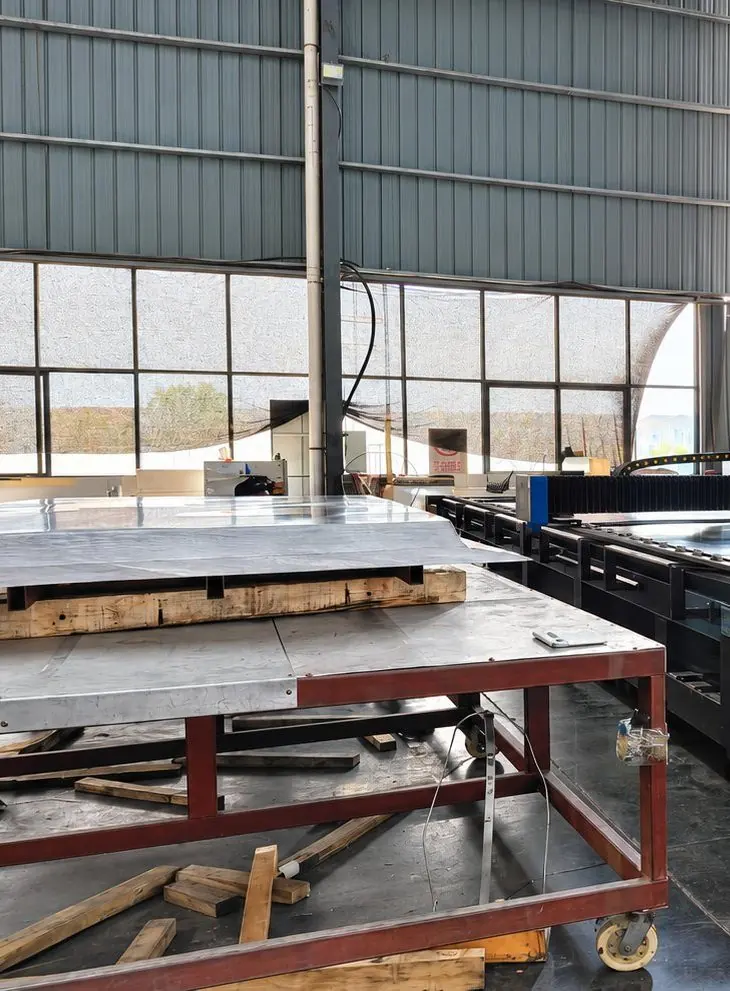
You send a size list or a drawing. We level the coil, cut to length and width, punch or laser the holes, deburr, film if you want it, and ship the parts stacked on a pallet — semi-finished, ready for your laminating, painting or assembly line.
Three ways to order, and they cost differently. A size list (length × width × quantity) is the cheapest: the shear does the work. A DXF adds laser time but gives outlines, holes and slots to ±0.2 mm. A sample is the slowest to quote and the safest to repeat, because we measure it and write the dimensions back to you before cutting.
What can be cut, and to what tolerance?
The process decides the tolerance, so the table is written by process rather than by product. If your drawing asks for a number in the laser column and you are quoted against the shear column, the quotation is for a different part.
| Process | What it makes | Tolerance | When it is the right answer |
|---|---|---|---|
| Shear / cut to length | Rectangles, strips, squares | ±0.5 mm length and width | Size lists, high volume, straight edges |
| Cut to width | Coil levelled and slit to a fixed width | ±0.5 mm on width | One width, long run, blank then sheared to length |
| Fibre laser | Outlines, holes, slots, radii, notches | ±0.2 mm | DXF parts, mixed shapes, small batches |
| Punch / notch | Corners, hole patterns, repeated features | ±0.2 mm on position | A pattern that repeats — cheaper than laser per part |
| Deburr | Edge finish after any of the above | ≤ 0.1 mm; ≤ 0.05 mm on request | Every part that will be filmed, painted or handled |
One part can use three processes: sheared to a rectangle, laser-cut for the outline detail, punched for the hole pattern. Ask for the split to be quoted separately if you want to see where the cost sits.
How do you place the order?
Four steps, and only the first one needs you.
How is it priced?
Metal and cutting are quoted as two lines, so you can see what the cutting actually costs. That matters when a size list can be redesigned: moving a part from 1180 mm to 1200 mm can turn a one-across layout into two-across, and the metal saving is usually larger than the cutting cost.
- Minimum
- One pallet, mixed sizes allowed
- Cutting
- Quoted per part, as a visible line — not buried in a unit price
- Tooling
- None for shear and laser; a punch die is quoted separately if a pattern repeats
- Lead time
- 15–20 days for stock alloys and cut parts, from approval of the size list
- Documents
- Invoice, packing list, mill certificate by heat, origin certificate on request
- Port
- Qingdao or Tianjin; CIF and FOB quoted side by side
Thickness, alloy, temper and the destination port. Everything else — how to nest it, which process to use, how to pack it — is our problem once those four are known.
Buyer questions
Can you cut from my DXF directly?
Yes. Outlines, holes, slots and radii are laser-cut to ±0.2 mm. Send the DXF with the thickness and alloy on the file name or in the email, because the same outline in 2.0 mm and 3.0 mm is two different jobs.
Do you charge for cutting?
Yes, as a separate line — per part for laser work, per cut or per tonne for shear work depending on the run. Keeping it visible is deliberate: it lets you see whether a small change in size saves more metal than it costs in cutting.
What is the smallest cut-to-size order?
One pallet. Below that the set-up and the freight per part stop making sense, and we would rather tell you than take the order and lose you on the second one.
Can parts be filmed before shipping?
Yes — PE film on one or both faces, or PVC where the part will be laser cut. Tell us which face, because filming the wrong side is a re-work, not a preference.
How do you stop the parts warping in the container?
Stack on edge where the part allows it, interleave, and strap without over-tensioning. A bundle that is supported along its length arrives flat; one that is supported at two points arrives bowed.
Related
Send the size list.
Length, width, thickness, quantity, alloy, port — the quotation comes back with the strip layout and the yield.